Does quantum physics explain why wise beings don't destroy?
🚀 Intro
It started with a simple question that wouldn’t let me rest.
One evening I was sitting with articles about dolphins cooperating with fishermen in Brazil, about elephants returning to the bodies of dead companions, about raven intelligence comparable to monkeys - and suddenly a thought struck me: why do the most intelligent beings on this planet consistently choose to build rather than destroy?
Because think about it - if intelligence were simply a tool for domination, then the cleverest species should be the most effective destroyers. In reality the opposite holds. Dolphins form multi-level alliances. Elephants mourn the dead. Ravens plan for the future and reconcile after quarrels. And humans - with all their flaws - built a civilization based on the cooperation of millions of strangers.
It’s fascinating. And I decided to pull this thread as far as it would go.
The journey took me to places I didn’t expect. From game theory and evolution, through the neurobiology of emotions, all the way to… quantum physics. Yes - quantum physics. Because it turns out that the answer to “why wise beings don’t destroy” may lie not in psychology or philosophy, but in the very structure of reality.
Welcome to a deep dive. It’ll be scientific but accessible - every term explained on the spot, every abstract concept clarified by analogy. I promise you don’t need any specialist knowledge. You only need curiosity.
📋 TL;DR
- Cooperation is not the negation of evolution - it’s its third pillar, alongside mutation and natural selection. Game theory mathematically proves that building is more profitable than destroying.
- Intelligence and emotion grow together - the evolution of the brain meant the simultaneous development of emotional and cognitive structures. The most intelligent species (dolphins, elephants, ravens) are also the most emotional.
- Expert intuition isn’t magic - it’s advanced pattern processing that works better in more intelligent beings.
- Consciousness may have quantum roots - the Orch OR theory of Penrose and Hameroff gained breakthrough experimental confirmation in 2024–2025.
- Empathy and cooperation may be written into the structure of the universe - if consciousness grows out of quantum coherence, then destroying relationships is destroying consciousness itself (HYPOTHESIS, requires further research).
- Exploitation is an evolutionary anomaly - it appears when an asymmetry of power lowers the costs of exploitation, but over the long run it always loses to cooperation.
🤝 Cooperation as the engine of evolution
The “survival of the fittest” myth
Most of us grew up with the image of evolution as a bloody arena where the stronger devours the weaker. “The law of the jungle.” “Survival of the fittest.” Sound familiar?
In fact this is one of the biggest misunderstandings in the history of science. The famous phrase survival of the fittest doesn’t even come from Charles Darwin - it was coined by the philosopher Herbert Spencer, in an economic, not a biological, context. Darwin spoke of “natural selection,” which is something quite different from “the law of the stronger.” The word fittest doesn’t mean “the strongest” - it means “the best fitted” to the environment. And as it turns out, the best-fitted are often beings that know how to cooperate.
Already at the start of the 20th century, the Russian naturalist Peter Kropotkin, doing field research in harsh Siberia, noticed something surprising: species living in extremely difficult conditions did not destroy each other. On the contrary - they showed a strong tendency toward mutual aid. He described this in the groundbreaking book Mutual Aid: A Factor of Evolution (1902), which was more than a hundred years ahead of its time.
Modern biology confirms Kropotkin’s intuition: cooperation is the third fundamental pillar of evolution, acting alongside mutation and natural selection. It isn’t an exception to the rule - it is the rule.
Five mechanisms of cooperation
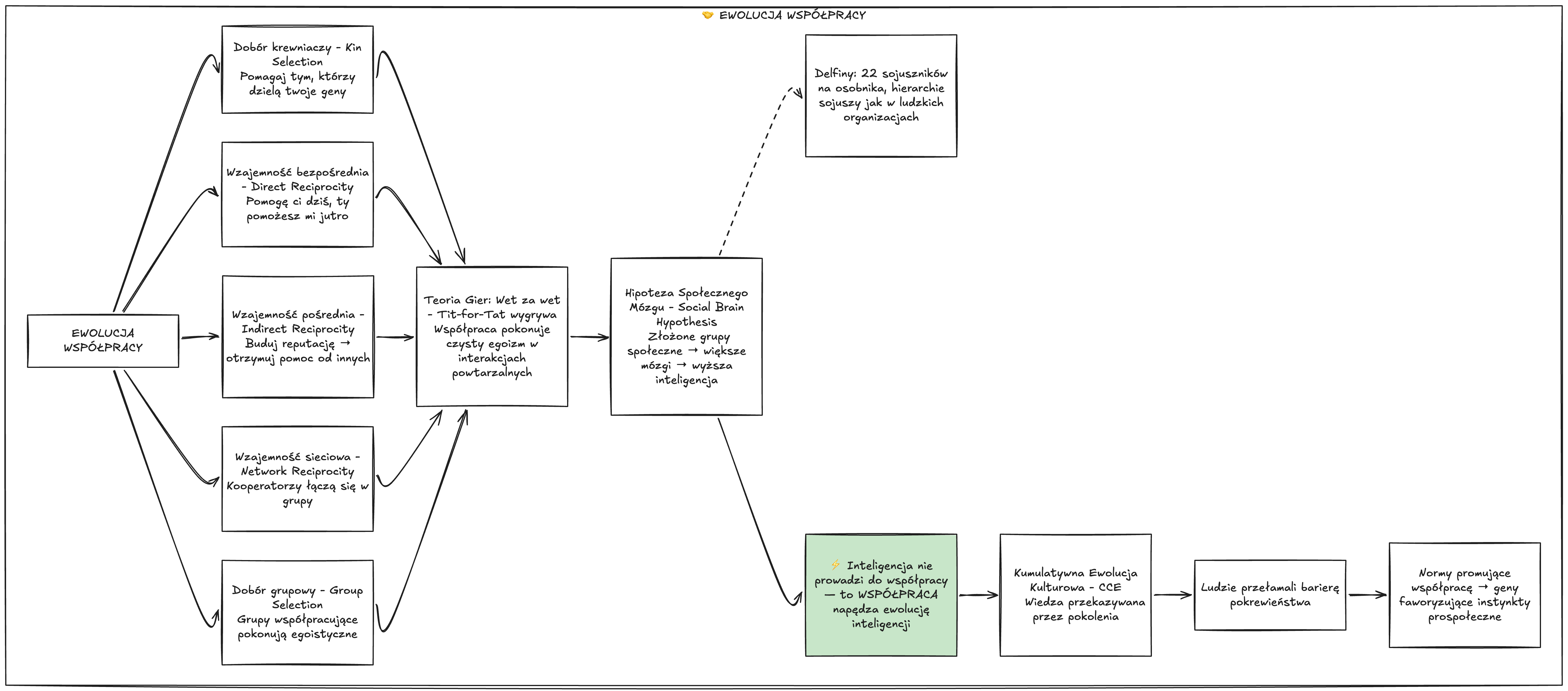
Scientists have identified five main ways evolution “invented” cooperation. Each works in a slightly different way, but all lead to the same conclusion: helping pays off.
1. Kin selection - we help those who share our genes. That’s why bees sacrifice themselves for the hive - by protecting the queen, they protect copies of their own genes. Mathematically this is captured by Hamilton’s rule: altruism pays when the cost to the giver is less than the benefit to the recipient multiplied by the degree of relatedness. This elegant equation explains why a mother will throw herself into a fire for her child but not necessarily for a stranger.
2. Direct reciprocity - “I’ll help you today, you’ll help me tomorrow.” It works when the same individuals meet repeatedly. Imagine it as an account in the bank of favors - you deposit today, withdraw tomorrow.
3. Indirect reciprocity - building reputation. Whoever helps others gains a good name and receives help from third parties in return. It’s like the rating system on a marketplace - you help strangers, because other strangers can see your history and are more willing to trust you.
4. Network reciprocity - cooperators cluster together in space, creating “islands of cooperation” resistant to cheaters. Like neighborhoods where neighbors know each other and watch out - a cheater is quickly identified and excluded.
5. Group selection - groups composed of cooperators beat selfish groups in inter-group competition. A team where everyone plays for the side beats a team of individualists - even when individual individualists are “stronger.”
Game theory: a mathematical proof that cooperation pays
Game theory is the mathematical method for analyzing strategic decisions - sounds dry, but the results are fascinating.
Robert Axelrod organized a famous computer tournament in which various strategies competed against each other in the iterated prisoner’s dilemma (a situation where two players must decide: cooperate or defect). Dozens of sophisticated algorithms were submitted - complex strategies with memory, bluffing, random defection.
The simplest strategy won: tit-for-tat. Start with cooperation. Then do whatever your partner did in the previous round. This strategy won because it is nice (it never attacks first), firm (it punishes defection immediately), and forgiving (it returns to cooperation when the partner stops cheating).
Think about what this means. Mathematics - the coldest of the sciences - is telling us that being nice but firm and forgiving is the optimal strategy. Not naivety. Not ruthlessness. Something in between. This isn’t moralizing - it’s pure probability theory.
Interestingly, brain studies show that the natural, intuitive reaction of many people is precisely cooperation - it’s only on longer reflection that some shift toward selfishness if it seems momentarily more profitable. Our brain is “set” to cooperation by default.
An important caveat: cooperation pays mostly when interactions repeat. In a one-off encounter with a stranger, cheating may be more “profitable.” That’s why cooperation flourishes in communities where people (or animals) meet regularly - and that’s why anonymity is the enemy of cooperation.
The social brain hypothesis
One of the most important findings of the past decades is the social brain hypothesis: the largest brains and the most advanced mental abilities appear in species living in complex social groups.
Three groups of mammals reached the peaks of brain development: primates (including humans), elephants, and cetaceans (dolphins and whales). What do they have in common? Life in complex social groups demanding constant cooperation, negotiation, and the building of alliances.
The bottlenose dolphins of Shark Bay in Australia form alliances on two-to-three levels of hierarchy - a complexity comparable to human corporate organizations. A single dolphin maintains relationships with an average of 22 allies. Decades of study have shown that the strength of social bonds predicts reproductive success - males with the strongest alliances have the most offspring. Not the physically strongest. Not the fastest. The ones with the best relationships.
And here we arrive at a key conclusion that turns common thinking on its head:
It isn’t intelligence that leads to cooperation - it’s cooperation that drives the growth of intelligence. The brain grows because you have to remember allies, understand relationships among others, and predict social behavior. Life in a group is the best training for the brain.
Cumulative cultural evolution - the human turbo-charger
In most mammals cooperation is limited to close relatives. The human species broke through this barrier thanks to cumulative cultural evolution (CCE) - the ability to pass knowledge, inventions, and social norms from generation to generation.
Imagine it like this: no single human, no matter how brilliant, could on their own invent, design, and build a kayak as used by Indigenous Arctic peoples. That kayak is the product of hundreds of generations of small improvements, passed from father to son. Each generation added a little - a better hull shape, more effective sealing, a more comfortable seat. The success of our species rests not on individual genius but on the capacity to accumulate knowledge.
This cultural evolution created a new environment for natural selection: communities that rewarded cooperation gained an enormous advantage over groups of egoists. Natural selection began to favor the genes responsible for prosocial instincts - the ability to feel empathy, to feel shame and guilt for breaking group rules, the need to belong.
| Criterion | Pure Darwinism (egoism) | Survival of the friendliest (cooperation) |
|---|---|---|
| Reach of cooperation | Only close kin | Huge groups of unrelated individuals |
| Mechanism of adaptation | Slow genetic evolution | Fast cultural evolution - passing knowledge |
| Approach to the weaker | The stronger take the resources | Protection of the weaker through moral systems |
| Outcome for the species | Limited development | Global dominance, civilization, space flight |
🌳 Cooperation across species boundaries
If cooperation is such a powerful tool of evolution, does it only work within a single species? Absolutely not. And here begins the truly fascinating part.
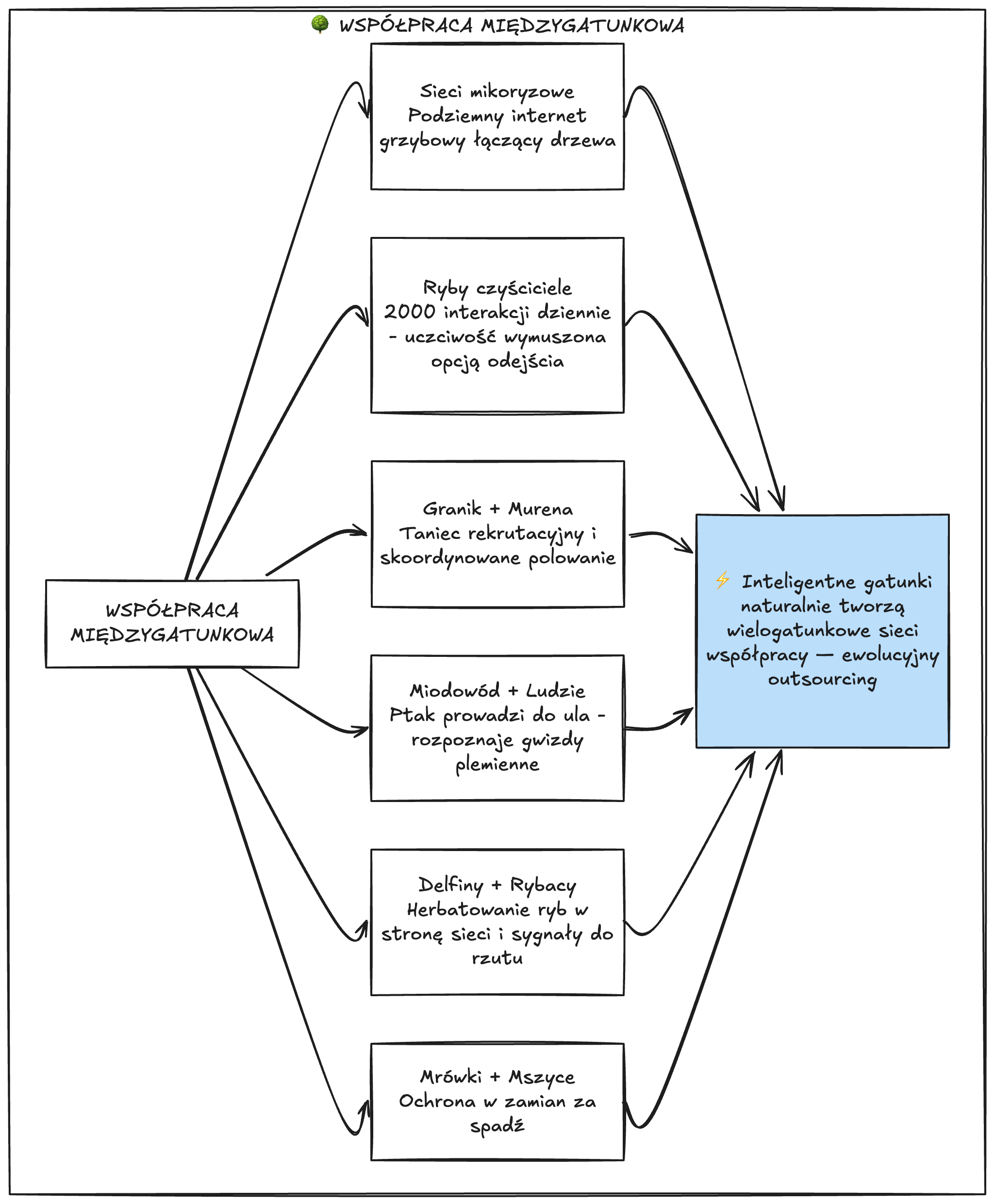
Instead of evolving over millions of years to develop new abilities, an intelligent species can simply strike an alliance with a smaller, specialized organism. It’s a kind of “evolutionary outsourcing” - why develop a new trait if you can cooperate with someone who already has it? It’s like a company that, instead of building its own IT department, hires specialists from outside.
Honeyguides and humans - the most beautiful cooperation between a human and a wild animal
In Africa there’s a remarkable relationship between wild birds called honeyguides and local honey hunters. The problem is simple: African bees nest in hidden, high-up hollows and defend their hives fiercely. The bird can locate bee swarms but is too small to break open the nest. Humans have smoke, fire, and axes, but from the ground they can’t find the hidden nests.
The solution? The bird, using a specific call, actively seeks out a human and leads them from tree to tree, straight to the bees’ nest. The human extracts the honey and in return leaves the bird pieces of wax and larvae.
What’s remarkable: these birds recognize the unique whistles of specific tribes. Honeyguides in the region of the Hadza people in Tanzania respond to the melodious whistle of local hunters but ignore the guttural grunts used by the Yao people in Mozambique, hundreds of kilometers away. This is a conscious pact of cooperation between a human and a wild, free animal - neither side is enslaved, both gain.
Dolphins and fishermen - a cultural tradition of cooperation
In southern Brazil, in the town of Laguna, wild bottlenose dolphins have for generations cooperated with the local fishermen. The dolphins drive shoals of fish toward the nets and signal to the humans the right moment to cast - with a particular dive the fishermen have learned to recognize. The catch rate for both species rises dramatically.
This isn’t a learned behavior in a lab - it’s a cultural tradition passed from generation to generation, both among the dolphins and among the fishermen. Young dolphins learn from their mothers, young fishermen from their fathers. This tradition has lasted at least 150 years. A similar phenomenon has been documented in Myanmar, where Irrawaddy dolphins cooperate with fishermen on the river.
Dolphins also cooperate with other marine species - with pygmy killer whales during hunts, and they even play with humpback whales. Intelligent species naturally tend to form multispecies networks.
Fungal networks - the forest’s internet
Underground, fungi form vast mycorrhizal networks (connections between plant roots and fungal mycelium) linking the roots of different trees and plants. Through these networks, fungi supply plants with nitrogen and phosphorus, while plants return up to 30% of the sugar they produce to the fungi. It’s trade - each side gives what it has in excess and gets what it needs.
But that isn’t all. Plants under attack by pests send chemical signals through the network warning their neighbors. Neighboring plants, having received the warning, begin to produce defensive substances before they themselves are attacked. It’s an early-warning system - like a military radar, but built out of mycelium.
What’s fascinating is that this complex cooperation works without any consciousness - it’s a purely biochemical communication system that evolved over millions of years. You don’t have to be smart to cooperate. But - as we’ll see - being smart makes cooperation even deeper.
Grouper and moray - tactical cooperation between predators
The grouper (a coral-reef fish) “recruits” moray eels for joint hunting. When prey hides in a crevice, the grouper swims to the moray and performs a particular dance - twisting and shaking. The moray understands the signal as an invitation. The grouper points with its head to where the prey is hiding. Both fish achieve a higher hunting success rate together than separately - the grouper hunts in open water, the moray in crevices. Together they leave the prey no escape route.
Octopuses cooperating with fish from the goatfish family work similarly - the fish sweep the bottom and indicate prey, and the octopus uses its arms to flush it out of places the fish can’t reach. It requires two-way communication and tactical coordination between entirely different species.
Cleaner fish - 2,000 interactions a day
Small cleaner wrasse swim without fear into the jaws of powerful predators - morays, sharks - and precisely pick parasites off their skin. The predator, though it could easily swallow the wrasse, holds back - it gains health in return for a small meal.
A single cleaner fish performs up to 2,000 cleaning interactions a day, serving hundreds of species of fish. It has to recognize hundreds of individual clients and remember their preferences - which requires surprisingly advanced mental abilities for a fish. And if it cheats (biting instead of cleaning), the client changes “cleaning station.” That option to leave keeps the relationship honest - remember this mechanism, because we’ll return to it in a moment.
Ants and aphids - livestock farming in miniature
Ants “farm” aphids the way humans farm cows. They protect them from predators and in exchange collect the sweet honeydew. Sounds like the perfect cooperation? Not quite - but more on the dark side of this relationship in a moment.
⛓ The dark side - when cooperation becomes slavery
If cooperation is so wonderful, why does exploitation exist? It’s one of the most important questions we can ask. And the answer is unsettlingly simple.
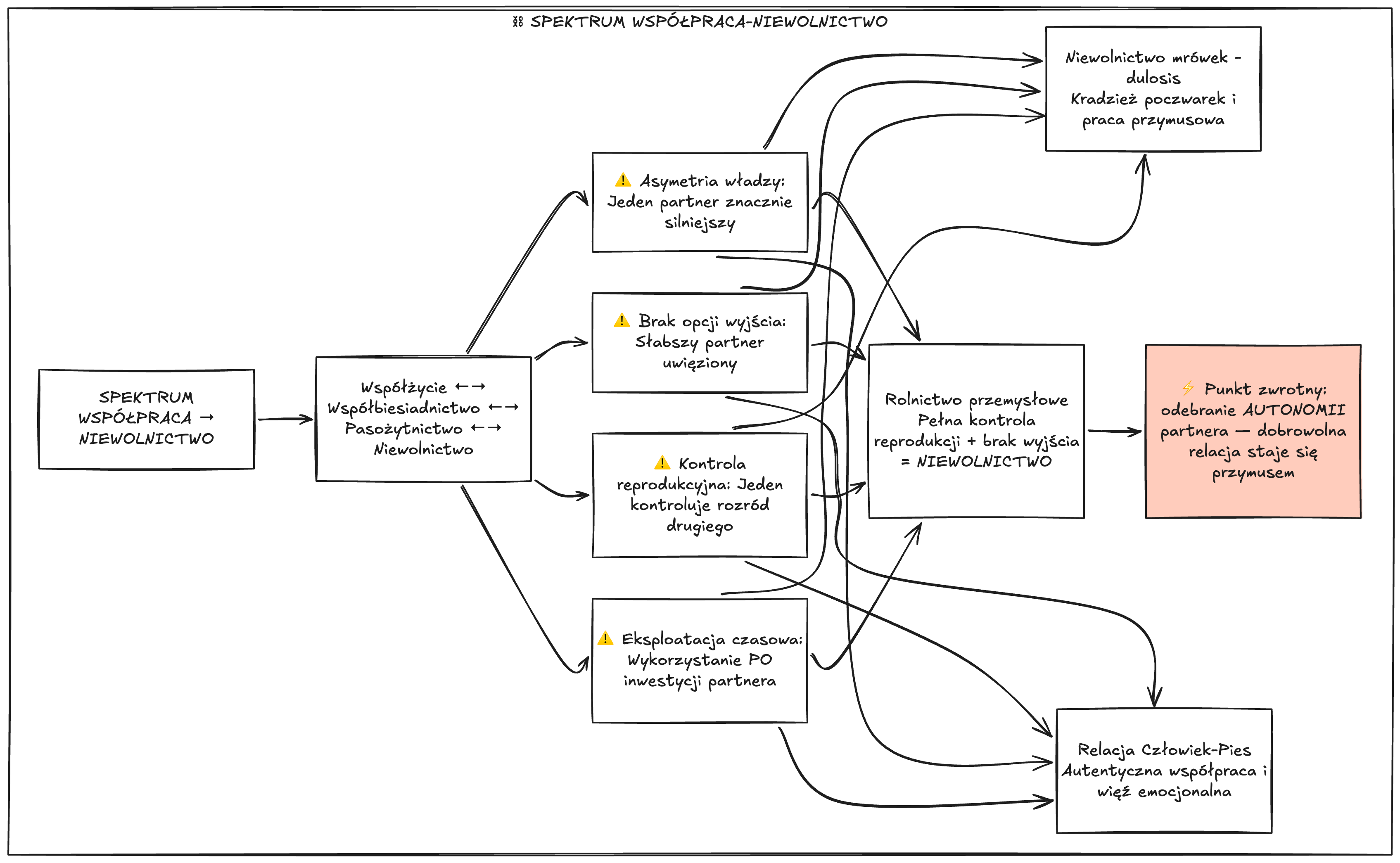
In nature there is no sharp boundary between cooperation and exploitation. Relationships between species exist on a continuous spectrum - from pure cooperation, through various forms of “grey zone,” all the way to full enslavement. This isn’t a matter of black-and-white categories but of fluid transitions.
Four critical points
Biologists have identified the precise conditions under which stable cooperation breaks down and tips into exploitation. You can think of them as four “red flags” - when they appear, the relationship starts to rot:
1. Asymmetry of power - when one partner is significantly stronger and discovers that fully subjugating the partner by force is less energetically costly than continuing a fair cooperation. It’s the difference between trade and robbery - trade requires both sides to be able to walk away from the table. Robbery requires only a power advantage.
2. No way out - remember the cleaner fish? Their clients can change “cleaning stations” - and that ability to leave keeps things honest. When the weaker partner is trapped - physically, economically, or technologically - the stronger can exploit them without consequence. The freedom to leave is the best guarantee of fairness.
3. Control over reproduction - when one partner controls the reproduction of the other, the relationship becomes a form of slavery. Ants of the species Lasius flavus farm underground aphids while eating their young as a protein source and restricting the development of their wings - so the aphids can’t fly away. It’s like a breeder who simultaneously protects and imprisons.
4. The temporal-sequence dilemma - exploitation is especially “profitable” when the exploitation phase comes late - after the partner has already invested in building a shared resource. It’s like a business partner who robs the company only after the other partner has put in all the capital. Once you’ve invested, it’s harder to leave.
Human and dog vs. industrial farming
The domestication of the dog is probably the closest example of true interspecies cooperation involving humans. Less skittish wolves approached human camps, living off scraps. Humans tolerated them because they warned of danger. Gradually both sides gained - the wolves got food and shelter, the humans got help in hunting and protection. Dogs developed unique abilities to read human gestures and emotions - emotional intelligence operating across species boundaries. A well-kept domestic dog, whose emotional and biological needs are met, is the continuation of that successful social contract.
At the other end of the spectrum we have the industrial farm - where the animal has been reduced to a biological machine. It has been stripped of reproductive autonomy, freedom of movement, the ability to meet basic needs. The philosopher Heather Kendrick introduced an important distinction here: autonomy freedom (the capacity for planning and desires - typically human) and preference freedom (the capacity to avoid pain and meet needs - shared by humans and animals). An animal on an industrial farm is deprived even of that second, basic freedom.
The Ingold hypothesis
The anthropologist Tim Ingold proposed a radical hypothesis: the shift to pastoralism and agriculture introduced a model of absolute dominance over animals - and the same model later served as a “template” for introducing slavery against other humans. First we learned to enslave animals; then we applied the same pattern to our own species.
It’s a provocative idea. But regardless of whether Ingold is right about the mechanism, one thing is clear: exploitation arises where an asymmetry of power meets a lack of any way out. And - as we’ll see further on - this is a fundamentally unstable state. Societies built on slavery ultimately fall. Systems built on exploitation generate resistance, revolutions, transformations. Cooperation is stable. Exploitation is not.
🧡 Emotions and intuition - allies of intelligence
Debunking the “smart = cold” myth
In mass culture two stereotypes of the exceptionally intelligent person circulate: either the hypersensitive empath soaking up emotion like a sponge, or the cold calculator devoid of feeling - the Sherlock Holmes or the Spock from Star Trek. Films and shows reinforce this image: a genius is someone who has “switched off emotion” in favor of pure reason.
Modern science debunks both myths. The truth is far more interesting - and far more beautiful.
Brain evolution - emotion grew alongside reason
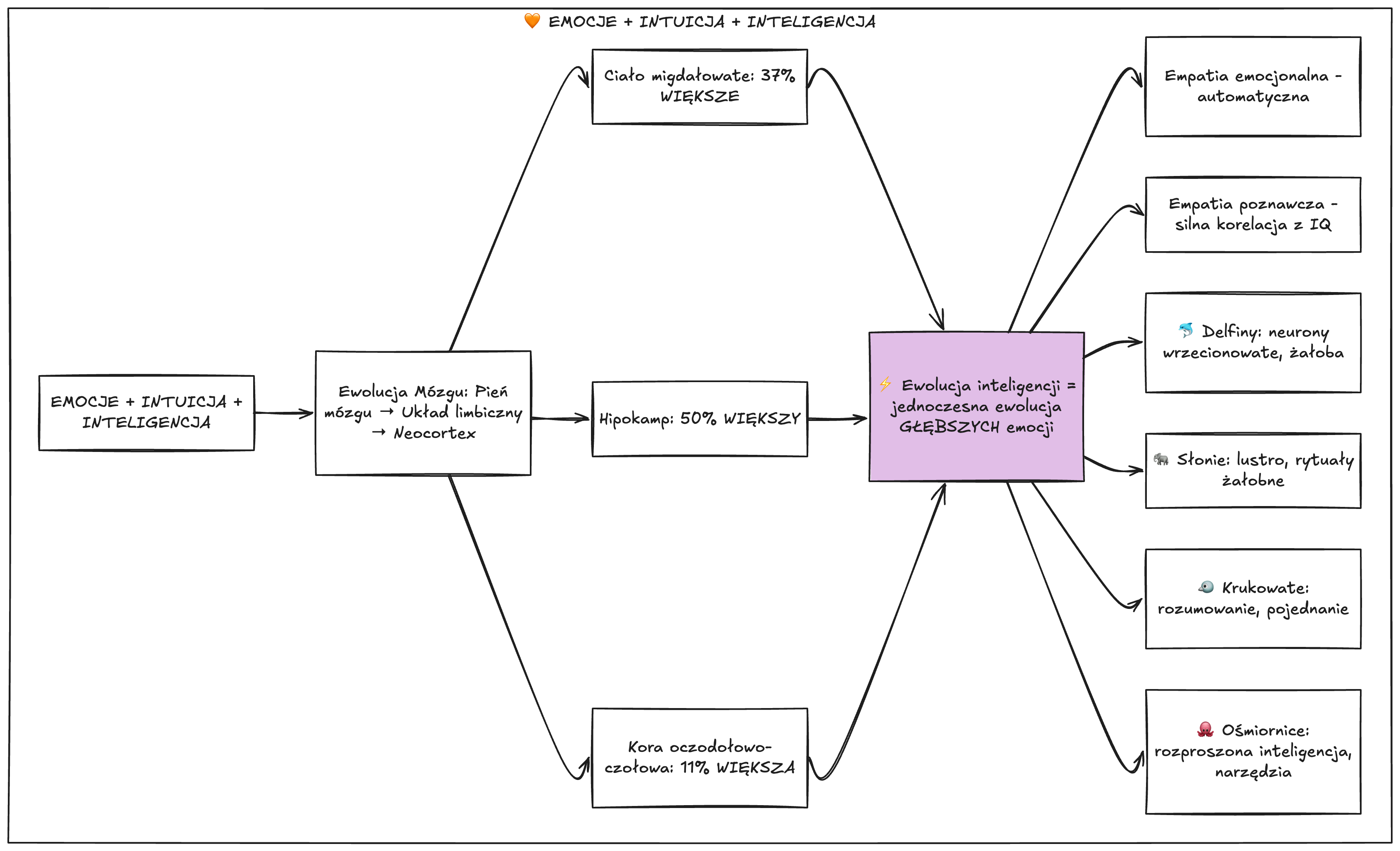
The human brain consists of three connected layers: the brainstem (instincts and basic life functions), the limbic system (emotion and memory, including the crucial amygdala), and the neocortex (logical thinking and planning). The key finding: human brain evolution did not consist in shrinking the emotional structures in favor of “rational” ones.
Quite the opposite. The human amygdala (the center of emotion) is 37% larger than in apes of comparable brain size. The hippocampus (key for memory and emotion) is 50% larger. The orbitofrontal cortex (linking emotions to decisions) is 11% larger.
The evolution of intelligence meant the simultaneous evolution of deeper emotions, not their suppression. We became smarter and more emotional at the same time.
It’s fascinating - and completely at odds with the popular image of the “cold genius.” Psychometric studies confirm this statistically: emotional intelligence and cognitive intelligence grow together. Exceptionally gifted people score higher not only on logic tests but also in the understanding, use, and regulation of emotion.
Two kinds of empathy
Science distinguishes two types of empathy, and the distinction is key to understanding why intelligent people are sometimes mistakenly perceived as “cold”:
Emotional empathy (affective) - an automatic, reflexive reaction to the suffering of others. You see someone crying and feel a tightness in your stomach. In high-IQ people this kind of empathy is at an average level - intelligence doesn’t make us catch emotions more strongly.
Cognitive empathy - the intellectual ability to precisely infer what another person thinks, feels, and what motivates them. This is advanced theory of mind - the ability to model another’s inner world. Here high-IQ people excel - they can decode the smallest social signals with surgical precision.
A frequently observed phenomenon: under stress, exceptionally intelligent people can suppress their own impulsive emotional reactions in order to keep their calm and clarity. This makes them sometimes unfairly perceived as “cold” - in fact they understand the situation perfectly, but they react with planning and analysis rather than with shared panic. It isn’t a lack of emotion - it’s its regulation.
Expert intuition - not magic, but turbo-charged reason
In everyday speech, intuition is “a sixth sense” or “a gut feeling.” Understood that way, as a purely emotional hunch, intuition rarely correlates with high intelligence - it often rests on cognitive biases and prejudice.
But there exists an entirely different kind of intuition: expert intuition, which neuroscience calls Superior Pattern Processing (SPP).
Imagine it like this: your brain stores thousands of experiences in complex “neural files.” When you encounter a new problem, the brain without conscious involvement searches those files in fractions of a second, links new information with existing knowledge, and creates new connections - in parallel, many patterns at once. When fragments of information come together into a new pattern - you experience a moment of “aha!”, the Eureka effect.
The decision feels like it was made “by feel,” but in reality it’s the result of a lightning-fast and extraordinarily complex analysis carried out in the background. It’s like an experienced chess player who “feels” that a move is good before they can analyze it - the brain has already searched through thousands of remembered games.
Studies show that people with the highest scores on logic tests, when making risky decisions, rely on their intuition more and more effectively than people of lower intelligence. The smarter the brain, the better the intuition - because it has more patterns to compare.
Emotions in the most intelligent animals
The strongest evidence for the link between intelligence and emotionality is in observations of the most intelligent species. And here it’s really worth pausing, because these examples are moving.
Dolphins have spindle neurons - special nerve cells associated with advanced social awareness (once thought to be unique to humans). Their limbic system (which processes emotion) is more complex than the human one. They create individual “names” - unique sound signatures - and remember the names of other dolphins for decades. Mothers have been observed carrying dead calves for many days - a behavior that points to grief. The neuroscientist Lori Marino put it this way: “A dolphin alone isn’t really a dolphin; being a dolphin means being embedded in a complex social network… even more than in humans.”
Elephants pass the mirror test (a proof of self-awareness - most animals can’t). They return repeatedly to the bodies of dead companions, touching them with their trunks. They try to cover the bodies with vegetation. They react to recordings of the voices of deceased family members - they search for them and call out for many days. These are behaviors hard to interpret as anything other than mourning.
Ravens and crows show cause-and-effect reasoning and planning for the future. After conflicts they engage in reconciliation behaviors - like primates. Neurological research has shown that crows possess a neuronal basis for subjective awareness - different individuals experience the same stimulus in different ways.
Octopuses - 2/3 of their 500 million neurons are in their arms, not in the brain. It’s “distributed intelligence.” They recognize individual humans and show preferences. They solve complex problems through play. They use tools - for example carrying half-coconuts with them as portable shelters.
A survey of 100 animal-behavior researchers showed: 98% attribute emotions to primates, 89% - to other mammals, 78% - to birds, 72% - to cephalopods. This is a fundamental shift from the 20th-century approach, which denied animals any emotion at all.
The most intelligent species are also the most emotional. Intelligence and emotionality are not opposites - they are two sides of the same coin.
🔗 From neurobiology to physics
We already know that intelligence, emotion, and empathy are inseparably linked - and that the most intelligent species are also the most emotional. But this raises a fundamental question: where does subjective experience even come from? Neurobiology can explain which brain areas activate during emotion, but it cannot explain why those activations feel like anything at all. A computer can process the same information as a brain - and feel nothing. To understand why empathy is something more than an algorithm, we have to go deeper - to the level of quantum physics.
✨ Microtubules - the quantum foundations of mind
The hardest question in science
Why do we see red as RED, instead of just processing a wavelength of light? Why does pain HURT, instead of being just an electrical signal? Why does music move us, instead of being just a sequence of vibrations in air?
This is the so-called “hard problem of consciousness” - a question that has haunted philosophers and scientists for centuries. The philosopher David Chalmers, who coined the term, put it this way: we can explain how the brain processes information, but we cannot explain why that processing is accompanied by subjective experience.
Classical neurobiology treats the brain like a computer - neurons are transistors, synapses are connections. But a computer has no subjective experience, even if it processes the same information as a brain. Something here doesn’t fit.
On top of that there’s the binding problem: different parts of the brain process color, shape, motion, and sound separately - and yet we experience the world as a coherent whole. How does the brain “bind” these separate streams into one “I”? It’s like an orchestra where each musician plays in a different room - and yet we hear one symphony.
What are microtubules?
Microtubules are tiny tubes (just 25 nanometers across - that’s 25 millionths of a millimeter, about a thousand times thinner than a human hair) built from a protein called tubulin. They sit inside every cell of our body, but are especially numerous in neurons - the brain’s nerve cells.
Until recently they were treated as just the cell’s “scaffolding” - something like the load-bearing beams of a building. But new research suggests they may serve a far more important role - they may be the place where consciousness is born.
Orch OR theory in four steps
The physicist and Nobel laureate Sir Roger Penrose and the anesthesiologist Stuart Hameroff created a revolutionary theory called Orch OR (Orchestrated Objective Reduction). The name sounds complicated, but the idea is fascinating. Let’s go through it step by step:
Step 1: The quantum world is strange. In the world of very small particles, strange rules apply. A particle can be in two places at once - it’s called superposition. Imagine a coin that is heads and tails at the same time, until you look at it. In a classical computer, the basic unit of information is the bit - it can be 0 or 1. In a quantum computer, the equivalent is the qubit, which thanks to superposition can be 0, 1, and every state in between, all at once.
Step 2: Microtubules as quantum computers. Penrose and Hameroff proposed that inside the microtubules in neurons there are π-electrons (electrons in special clouds around the tubulin proteins) whose oscillating charges create qubits. These qubits remain in superposition, processing information in a way unavailable to classical computers.
Step 3: The moment of consciousness. When superposition reaches a certain threshold (linked to gravity and the curvature of spacetime), a spontaneous “collapse” occurs - the coin “decides” on heads or tails. Each alternative possibility in superposition creates a microscopic curvature in the fabric of the universe - something like a “bubble in spacetime.” When too many of these bubbles accumulate, they become unstable and collapse. That moment of collapse is, according to the theory, the moment of consciousness - a single flash of subjective experience. The theory predicts about 40 such moments per second, which corresponds to the brain’s gamma waves.
Step 4: Orchestration. For this process not to lead to chaos, specific proteins that bind to microtubules (the so-called MAP proteins) “orchestrate” (guide) these quantum processes. Signals from synapses, memories, and sensory stimuli “tune” the quantum system, giving our thoughts continuity and meaning. Hence “orchestrated” in the name.
A beautiful analogy from Hameroff:
The brain doesn’t really resemble a computer running dry algorithms. It’s much more like a great symphony orchestra playing music. The microtubules are the percussion section, setting an extraordinarily fast, vibratory rhythm for the whole brain. Consciousness is not the result of a mathematical equation, but a complex melody resonating directly with the structure of the universe itself.
Orch OR theory also elegantly solves the binding problem: quantum entanglement (the phenomenon in which two particles are connected regardless of distance) between microtubules in different parts of the brain creates a single integrated quantum state. When that state collapses, all elements “decide” at once - producing a coherent, unified experience.
The evidence from anesthesia
One of the strongest arguments for this theory is the way anesthetics work - and here the story gets really interesting.
For more than a hundred years it has been known that the potency of anesthetics is almost perfectly proportional to their solubility in olive oil (the Meyer-Overton puzzle). That’s strange - chemically different substances (from noble gases to complex molecules) all work according to the same principle. This suggests they all act on the same molecular target - but which one?
A breakthrough study from 2024: researchers at Wellesley College gave rats a microtubule-stabilizing drug (epothilone B) and then tried to put them under with isoflurane. The result: rats with stabilized microtubules were significantly more resistant to anesthesia. This suggests that anesthetics act primarily on microtubules - and that microtubules are key to consciousness.

🔬 The 2024–2025 breakthrough - three discoveries that change everything
The main argument against Orch OR theory ran for years: “the brain is too warm and too wet for quantum processes.” The physicist Max Tegmark calculated in 2000 that quantum coherence (the persistence of quantum states) in the brain should last just 10⁻¹³ seconds - too short to have any meaning. It was like saying a candle can’t burn underwater.
The years 2024–2025 demolished that argument. And not with one breakthrough finding, but with three. The candle, it turns out, can burn underwater - if it’s built the right way.
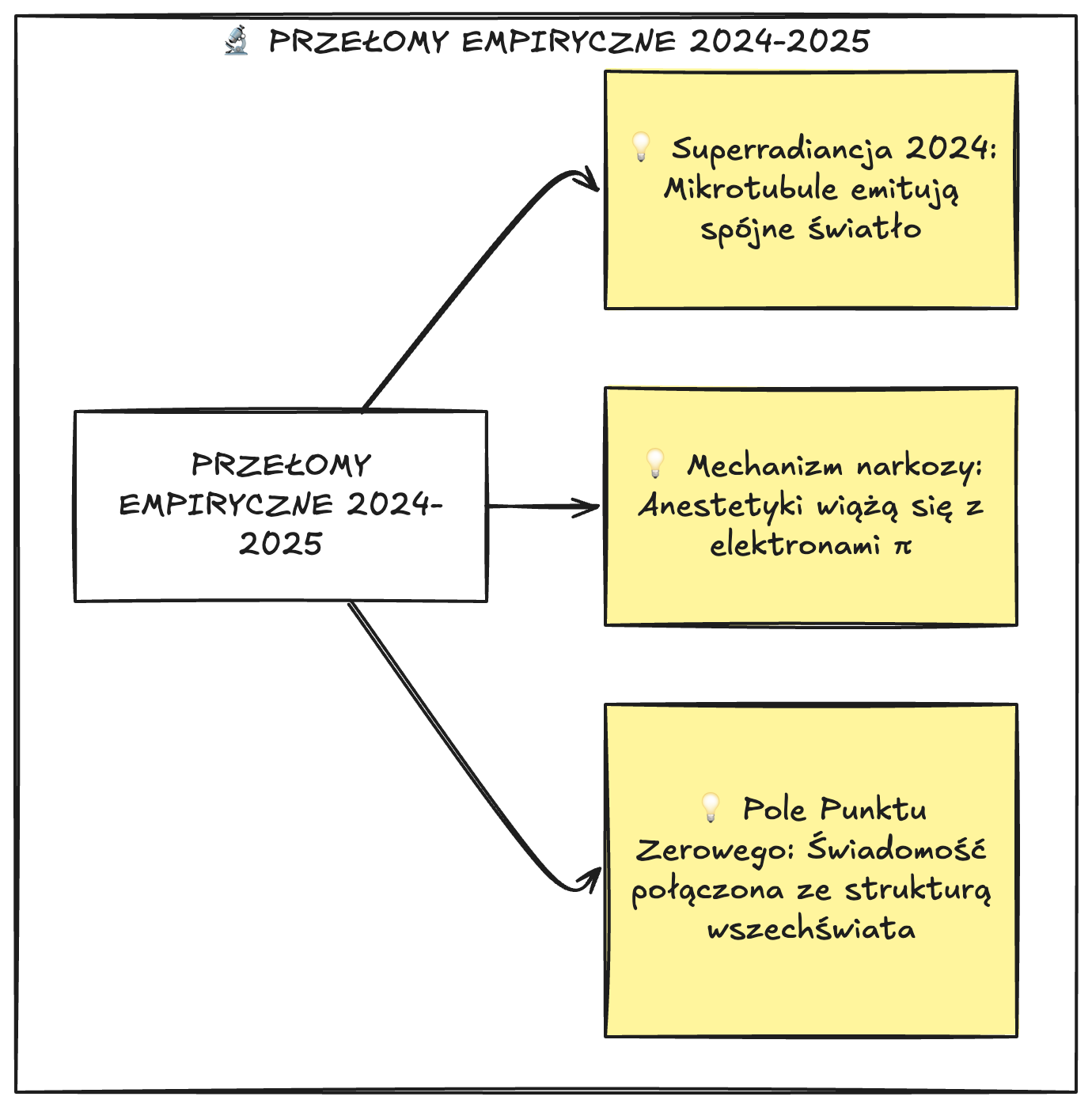
💡 Finding 1: Superradiance in microtubules (Kurian & Babcock, 2024)
The teams of Kurian and Babcock experimentally proved the phenomenon of macroscopic superradiance in cylinders of tryptophan (an amino acid) modeling the structure of microtubules.
What does that mean in plain language? Superradiance is the phenomenon in which a group of molecules emit light in a coordinated, coherent way - like a choir singing in perfect unison instead of each on its own. A single singer is quiet. But when a thousand singers sing exactly the same note at the same moment, the effect is disproportionately greater than the sum of their individual voices.
This is proof that the proteins building microtubules can sustain quantum states even in the warm, wet biological environment. Tegmark argued that was impossible. The experiment showed he was wrong.
💡 Finding 2: The mechanism of anesthetics - π-electrons
It was shown that anesthetics block consciousness precisely by binding to the π-electrons of microtubules, destroying quantum phenomena. Crucially: anesthetics do not act on the synapses (the connections between neurons), as was previously thought - they act directly on quantum processes inside neurons.
It’s like discovering that the light switch in a house isn’t where we thought it was (by the door) but deep inside the wall (in the microtubules). For decades we’d looked for the mechanism of consciousness in synapses - and it was hidden deeper.
💡 Finding 3: Synchronization with the Zero-Point Field - ZPF (Keppler/SOC)
Joachim Keppler, using quantum electrodynamics (QED - the theory describing the interaction of light with matter), showed that microtubules synchronize with the fundamental Zero-Point Field (ZPF).
What is the Zero-Point Field? It’s the lowest possible energy state of the quantum vacuum - even in absolutely empty space, tiny fluctuations of energy exist. Imagine a perfectly still lake - even then microscopic ripples appear on its surface. The Zero-Point Field is those “ripples” of reality itself. It is ubiquitous and fundamental to the structure of the universe.
According to Keppler, the synchronization of microtubules with the Zero-Point Field keeps the brain in a state of Self-Organized Criticality (SOC) - a state on the boundary between order and chaos that is optimal for processing information. It’s like a surfer on the crest of a wave - neither too far forward (chaos), nor too far back (stagnation).
This means something profound: consciousness isn’t locked inside the skull - it’s connected to the fundamental structure of the universe.
Additional confirmations from the same period: MRI studies detected signals suggesting quantum entanglement in the living human brain - signals that appeared only during consciousness and disappeared during sleep. And experiments by Bandyopadhyay’s group showed that stimulating quantum resonances in microtubules directly controls cell-membrane voltage - meaning it affects whether a neuron “fires” a signal or not. Quantum processes in microtubules really do influence how the brain works.
🌌 The grand synthesis - quantum foundations of empathy
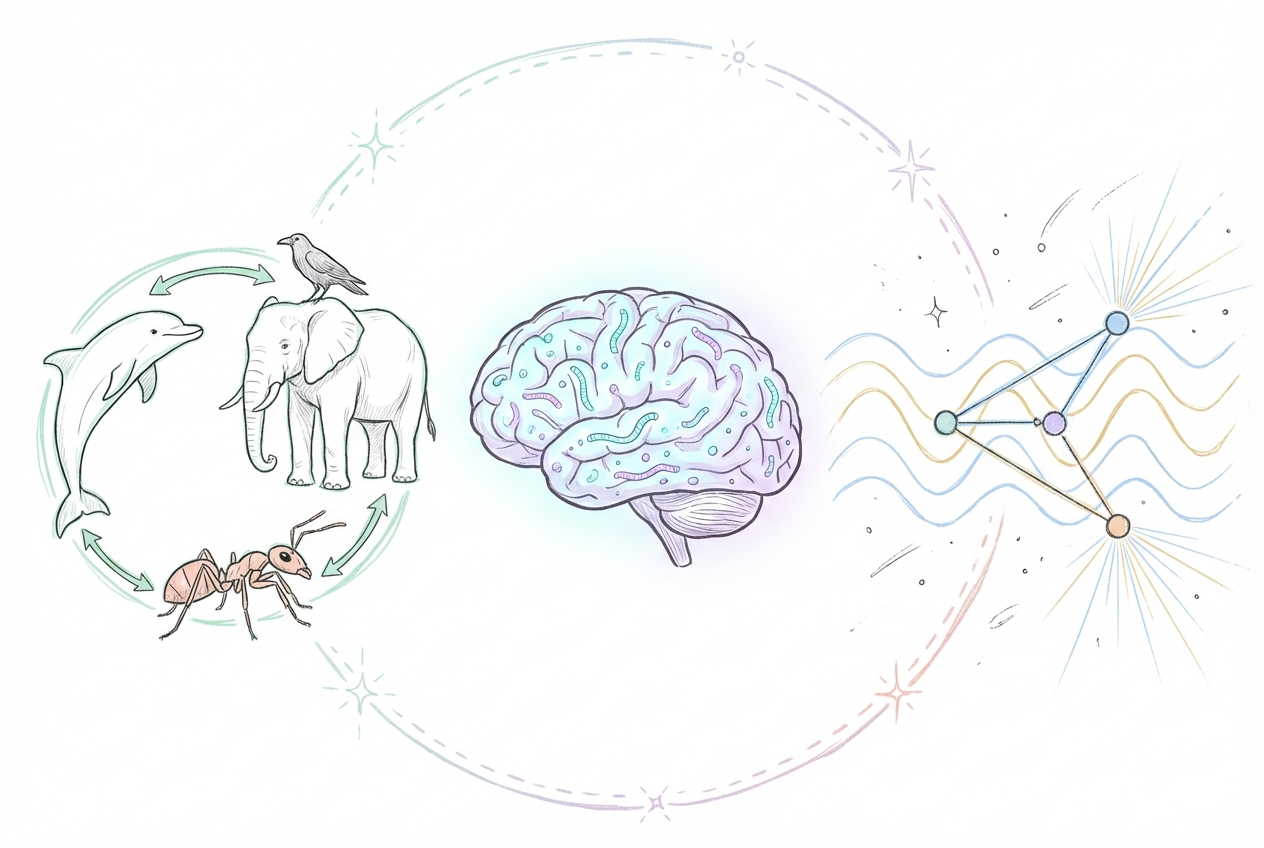
We’ve reached the point where we can tie all the threads together into one coherent whole. This is the part in which seemingly distant topics - ants farming aphids, dolphins cooperating with fishermen, spindle neurons and quantum collapse - start to form a single picture.
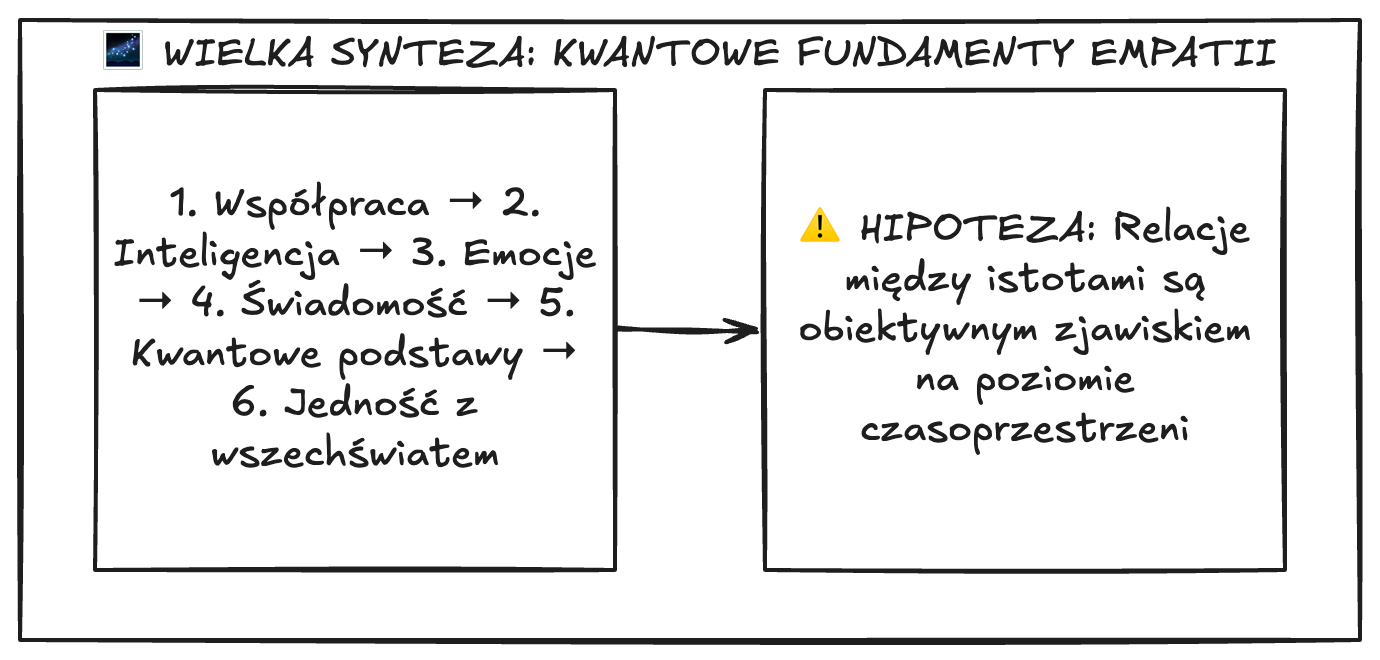
Let’s trace the logical chain - six steps, each following from the previous:
1. Evolution favors cooperation - game theory, group selection, and cultural evolution show that building is more profitable than destroying.
2. Cooperation requires intelligence - you have to understand the intentions of others, remember allies, predict behavior.
3. Intelligence develops together with emotion - the evolution of the brain meant the simultaneous growth of emotional and cognitive structures.
4. Emotions and empathy require consciousness - to feel-with, you have to feel in the first place.
5. Consciousness has quantum roots - Orch OR theory and the latest experiments suggest that consciousness arises from quantum processes in microtubules.
6. Quantum processes link consciousness with the fundamental structure of the universe - synchronization with the Zero-Point Field.
And now the key step - what follows from this?
Hypothesis: quantum entanglement between conscious beings
A reminder: quantum entanglement is the phenomenon in which particles become connected regardless of distance - Einstein called it “spooky action at a distance.” Changing the state of one particle instantly affects the state of the other, even across light-years.
If Orch OR theory is true and consciousness rests on quantum processes, then quantum entanglement means something profound: relationships between conscious beings are not merely a metaphor - they may be objective phenomena at the level of spacetime itself.
⚠️ Important caveat: This is currently a HYPOTHESIS, not a proven fact. The experiments so far confirm the existence of quantum processes inside individual brains, but quantum entanglement between separate conscious beings has not yet been experimentally demonstrated. The reasoning that follows is a logical extrapolation - a fascinating one, and consistent with the data so far, but it needs further research. I treat this as a working hypothesis, not a certainty.
The thermodynamic argument
If quantum coherence (the consistency of quantum states) links consciousness with the Zero-Point Field - the ubiquitous energetic foundation of the universe - then deep empathy and the drive to build become a natural and thermodynamically privileged state.
What does “thermodynamically privileged” mean? Imagine a ball at the top of a mountain - it can stand there, but it naturally tends to roll down into the valley. It takes energy to hold it up there. Similarly, if consciousness is connected to the quantum structure of the universe, then cooperation and empathy are like that valley - the state the system naturally tends toward. Destruction requires extra energy - it’s like pushing the ball uphill.
Destroying relationships and bonds means destroying coherence - and so destroying consciousness itself. Building, cooperation, and empathy, by contrast, are strengthening coherence - and so strengthening consciousness. The deeper the relationships, the more cooperation, the stronger the coherence - and the richer the consciousness.
Exploitation as anomaly
What, then, about slavery, exploitation, and destruction? If cooperation is the “natural state,” why does exploitation exist?
The answer lies in the concept of a cost anomaly. As we saw in the chapter on the dark side of cooperation, exploitation appears when an asymmetry of power drastically lowers the costs of exploitation, technology makes it possible to control a partner, and short-term gain hides long-term loss.
But in evolutionary terms, exploitation and slavery remain mere momentary anomalies that block higher levels of integration. They’re like a short circuit in an electrical circuit - it can momentarily throw a spark, but in the long run it destroys the whole system. Exploitation is entropy - the breakdown of order. Cooperation is negentropy - the building of order.
The history of human civilization confirms this pattern: societies built on slavery and exploitation ultimately fall or transform, while societies that expand the circle of cooperation - from family, through tribe, nation, all the way to international community - reach ever higher levels of complexity and prosperity. The circle of empathy widens - slowly, with setbacks, but consistently.
🎯 Summary
Five key conclusions
1. Cooperation isn’t idealism - it’s mathematics. Game theory, evolutionary biology, and observations of hundreds of species show that building is more profitable than destroying. Cooperation is the third pillar of evolution.
2. Intelligence and emotion are a package deal. Evolution did not create “cold calculators” - it created beings in whom reason and emotion grow together. The most intelligent species on Earth are also the most emotional.
3. Consciousness has quantum foundations. Orch OR theory, supported by the breakthrough discoveries of 2024–2025 (superradiance, the mechanism of anesthetics, synchronization with the ZPF), suggests that subjective experience arises from quantum processes in the microtubules of neurons.
4. Exploitation is an anomaly, not the norm. It appears when an asymmetry of power lowers the costs of exploitation, but in the long run it always loses to cooperation - both at the biological and the civilizational level.
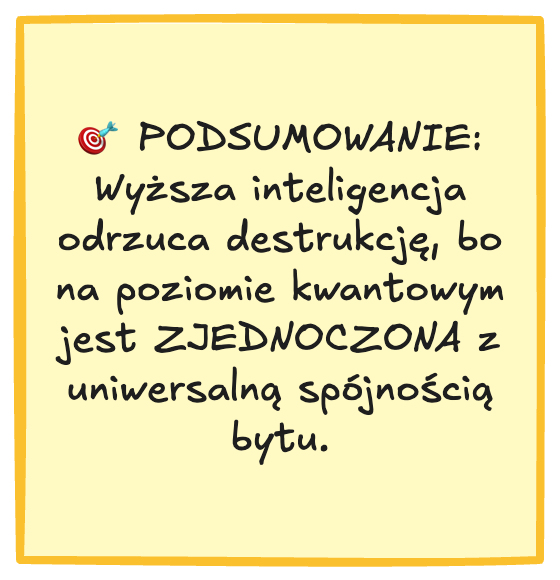
5. Empathy may be written into the structure of reality. If consciousness grows out of quantum coherence linked to the fundamental Zero-Point Field, then cooperation and empathy are not merely survival strategies - they are an expression of the universe’s deepest nature.
A personal reflection
When I started this journey, I was looking for an answer to a simple question: why don’t wise beings destroy? I didn’t expect the answer to lead me from ants farming aphids, through dolphins cooperating with fishermen, all the way to the quantum structure of spacetime.
But that is the most beautiful thing about science - seemingly distant questions lead to surprisingly coherent answers. Evolution, neurobiology, and quantum physics - three completely different fields - tell us the same thing: building is fundamentally more in tune with the nature of reality than destroying.
Does this mean destruction will disappear? No. But it means it’s an anomaly - a momentary short circuit in a system that naturally tends toward coherence, cooperation, and mutual amplification. Every relationship built on exploitation is unstable. Every relationship built on cooperation - strengthens itself.
And that’s fascinating. Because if it’s true, the deepest answer to the question “why is it worth being good” comes not from religion, philosophy, or morality - it comes from physics.
In the next article we’ll think about what all of this means for artificial intelligence. If consciousness requires quantum processes in microtubules - can AGI built on classical computers ever truly feel? And what does that mean for the future of relationships between humans and machines?
📚 Sources
Cooperation and evolution
- Kropotkin, P. (1902). Mutual Aid: A Factor of Evolution
- Axelrod, R. (1984). The Evolution of Cooperation
- Doebeli, M. & Hauert, C. (2005). Models of cooperation based on the Prisoner’s Dilemma. Ecology Letters
- Van Cleve, J. (2017). Kin selection and the evolution of social traits. PMC
- Richerson, P. & Boyd, R. Culture and the evolution of human cooperation. PMC (PMC2781880)
- Leakey Foundation. The Evolutionary Benefits of Cooperation
Interspecies cooperation
- Spottiswoode, C. et al. Successful honey-hunters know how to communicate with wild birds. University of Cambridge
- National Geographic. These birds help humans find honey
- ScienceDaily (2025). Some animals cooperate with members of other species
- Natural History Museum. Mutualism: Eight examples of species that work together
From cooperation to slavery
- Clutton-Brock, J. The Wild Side of Animal Domestication. ResearchGate
- Ingold, T. The pastoral domination hypothesis
- Kendrick, H. Autonomy, Slavery, and Companion Animals. Cal Poly Digital Commons
- PMC (2016). Temporal Structure in Cooperative Interactions (PMC4739704)
Emotions, intuition and intelligence
- PsyPost. New review challenges the idea that highly intelligent people are hyper-empathic
- PMC (2014). Superior pattern processing is the essence of the evolved human brain (PMC4141622)
- PMC (2015). Good Thinking or Gut Feeling? Cognitive Reflection and Intuition (PMC4395391)
- Wild Dolphin Project. How intelligent are dolphins?
- PMC (2012). Neuroscience of empathy (PMC3524680)
- PMC (2013). Evolution of brain emotion systems (PMC3600914)
Microtubules and consciousness
- Penrose, R. & Hameroff, S. Orchestrated Objective Reduction (Orch OR)
- Hameroff, S. Is your brain really a computer, or is it a quantum orchestra? Interalia Magazine
- Kurian, P. & Babcock, N. (2024). Macroscopic superradiance in microtubules
- Keppler, J. Quantum electrodynamics (QED) and the Zero-Point Field (ZPF)
- ScienceDaily (2024). Anesthesia and microtubules
- Popular Mechanics (2025). Consciousness connects with universe
- Oxford Academic (2025). Neuroscience of Consciousness (niaf011)
- PMC (2025). Microtubules and anesthesia (PMC12413878)
- ArXiv (2025). Quantum effects in microtubules (2505.20364v1)
The article is based on a synthesis of three independent research summaries drawing on more than 70 scientific sources in total. Last updated: February 2026.